The Ear That Forgot How to Listen:
ON MUSIC, ANXIETY, AND LEARNING TO LISTEN THROUGH THE BODY AGAIIN
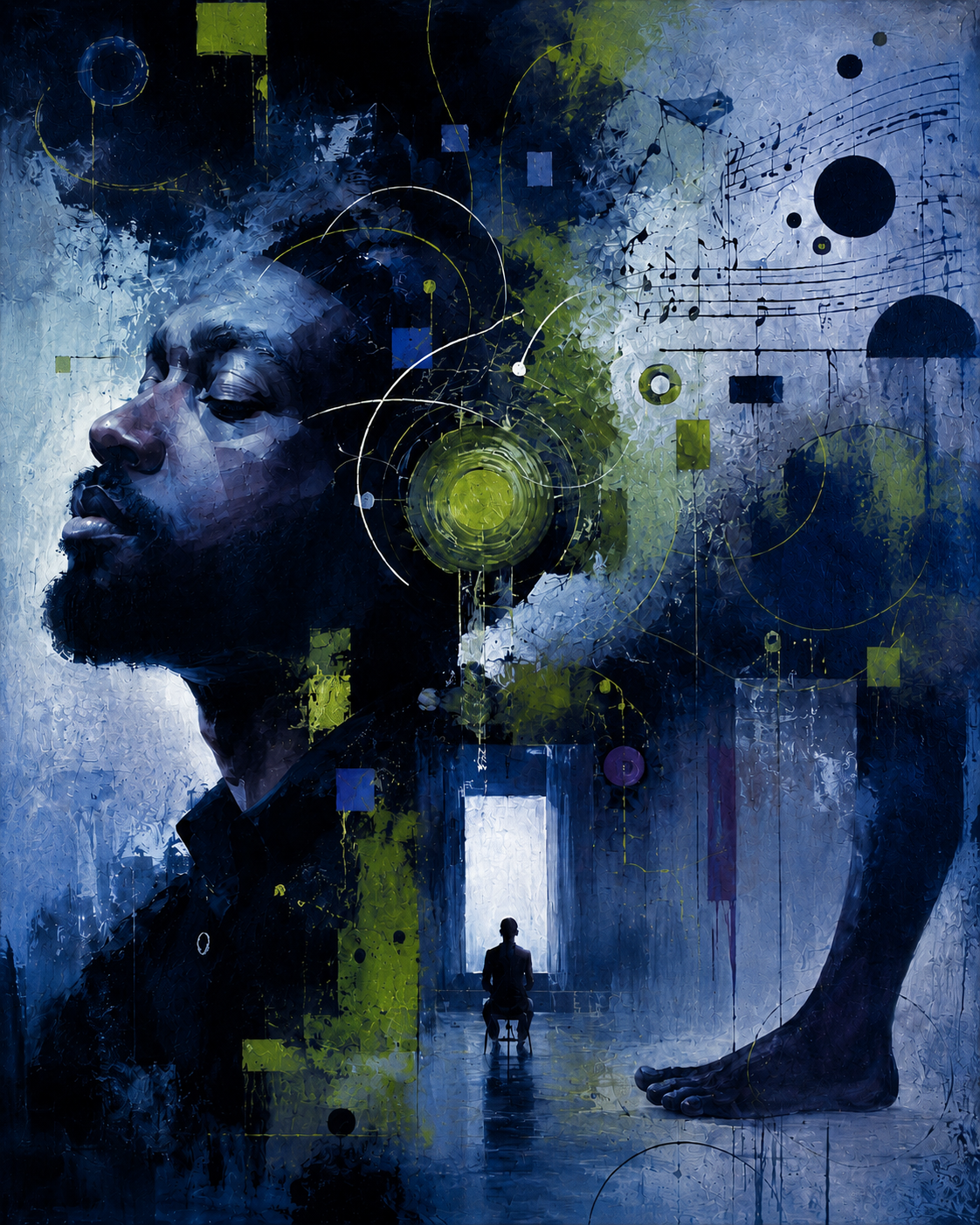
Image created with DALL·E.
5/29/2026
The Ear That Forgot How to Listen:
On music, anxiety, and learning to listen through the body again
I used to think this was simply what happened when you made music your life. The professional’s occupational hazard: the chef who stops tasting dinner and starts auditing it. I told myself I was lucky to love what I do so much that I could not turn it off.
Lately, I have started to wonder if that story was too convenient. Maybe it helped me make peace with an absence I did not know how to name.
Here is what my life actually looks like right now: two universities, opposite sides of Los Angeles. Office hours, rehearsals, lectures, practice rooms. A marriage that deserves more presence than I sometimes give it. Freeway miles that stack up like unpaid debt. The particular fatigue of a city that asks you to be somewhere else before you have finished being where you are.
I have been anxious for years. Not dramatically. Not always in a way that announced itself clearly. More like a low, continuous hum running underneath whatever else I was doing. Academia gave me an intellectual vocabulary for nearly everything except what was happening in my own body. The musician in me kept playing. The teacher kept teaching. Somewhere underneath all of it, something was quietly going numb.
I was not listening to music. I was monitoring it. And I had been doing the same thing to myself.
It took sitting with a therapist, and later finding my way into writing about mindfulness and contemplative practice, to understand that what I had lost was not only the pleasure of listening. I had lost access to my own interior life. The trained ear and the anxious mind had merged into one efficient, always-on instrument of analysis. Nothing entered without being processed first. Felt second, if at all.
The practice that cracked something open was almost embarrassingly simple. Put on a song. Do not analyze it. Notice what your body does.
Does your toe tap? Does something in your chest open or tighten? Does your breathing change? Do your shoulders drop? Does your jaw unclench? These are not metaphors. They are information. The body gives its report before the analytical mind can intervene and reclassify the experience as content.
For a musician who had spent years turning sensation into knowledge, the toe tap felt almost radical. It was not analysis. It was response. It came before usefulness. My foot knew something my brain was too busy to notice.
I think about Llewellyn Vaughan-Lee, a Sufi teacher and writer whose work often returns to the heart as an organ of spiritual attention. He writes about the ear of the heart, the idea that there is a form of listening that does not begin with cognition. It comes through attention, stillness, and a slower kind of receptivity. I am not there yet. I am still learning what that distance feels like. Even that feels like progress.
I want to be careful not to make this sound like an arrival. I am not writing from the other side of anything. The traffic is still real. The teaching load is still real. Anxiety does not vanish because you noticed your foot tapping. The thoughts still fire. The defenses still engage. The body still holds things the mind refuses to face directly.
But something has changed, even if I cannot fully account for it. Sometimes I sit with a record now without trying to study it, classify it, or store it for later. I let it occupy the room. Occasionally, something lands. Not as information. As feeling. As the thing music was trying to do before I learned how to intercept it.
Harmony Holiday, a poet and critic whose writing on Black music treats listening as memory, archive, and cultural responsibility, has described music writing as a deeper contextual practice, something worthy of the music it covers rather than tethered to the speed of releases, markets, and industry cycles. I have been thinking about that in relation to my own life. I want to write about music in a way that still leaves room for feeling. I want to listen without immediately turning the experience into work. I want to notice what the body knows before the trained ear begins organizing everything into data.
That is part of why I am writing this. Not because I have figured it out, but because writing is one way I figure things out. The page gives me a place to notice the mess of it, the fatigue, the anxiety, the small clearings, and the strange relief of realizing that pleasure may still be available, even after years of turning it into labor.
If you are a musician who has lost the pleasure of listening, or if you are someone who made a passion into a profession and felt something slowly leave the room, I do not have a solution. I have a starting point.
Put on a song.
Notice if your toe taps.
That may be the first sign that listening is returning to the body. Stay with it.